

Close Menu
New York Daily News Online
    Facebook X (Twitter) Instagram Pinterest YouTube
    Facebook X (Twitter) Instagram YouTube TikTok
    New York Daily News OnlineNew York Daily News Online
    • Home
    • US News
    • Politics
    • Business
    • Technology
    • Science
    • Books
    • Film
    • Music
    • Television
    • LifeStyle
    • Contact
      • About
      • Amazon Disclaimer
      • DMCA / Copyrights Disclaimer
      • Privacy Policy
      • Terms and Conditions
    New York Daily News Online
    Home»Science

    Using quantum entanglement to probe hidden properties of quarks

    AdminBy AdminOctober 7, 2026Updated:October 15, 2026 Science
    Facebook Twitter Pinterest LinkedIn Tumblr Email Reddit
    Using quantum entanglement to probe hidden properties of quarks


    Researchers propose a new way to search for physics beyond the Standard Model by studying quantum-entangled quark pairs produced in electron-positron collisions

    Particle collision
    Particle collision (Courtesy: iStock/Girolamo Sferrazza)

    A quark is a fundamental building block of matter. There are six types known as flavours of quark: up, down, strange, charm, bottom, and top. Quarks combine to form particles known as hadrons. Most ordinary matter is made from up and down quarks, for example, a proton consists of two up quarks and one down quark, while a neutron consists of one up quark and two down quarks. Electrons belong to a different family of particles called leptons and are not made of quarks.

    Particle physicists continuously test the Standard Model of particle physics to search for signs of new phenomena. One possibility is that quarks possess anomalous magnetic or electric dipole moments, which would indicate physics beyond the Standard Model. However, quarks are never observed in isolation because they are confined inside particles such as protons and neutrons.
    Using quantum entanglement to probe hidden properties of quarks
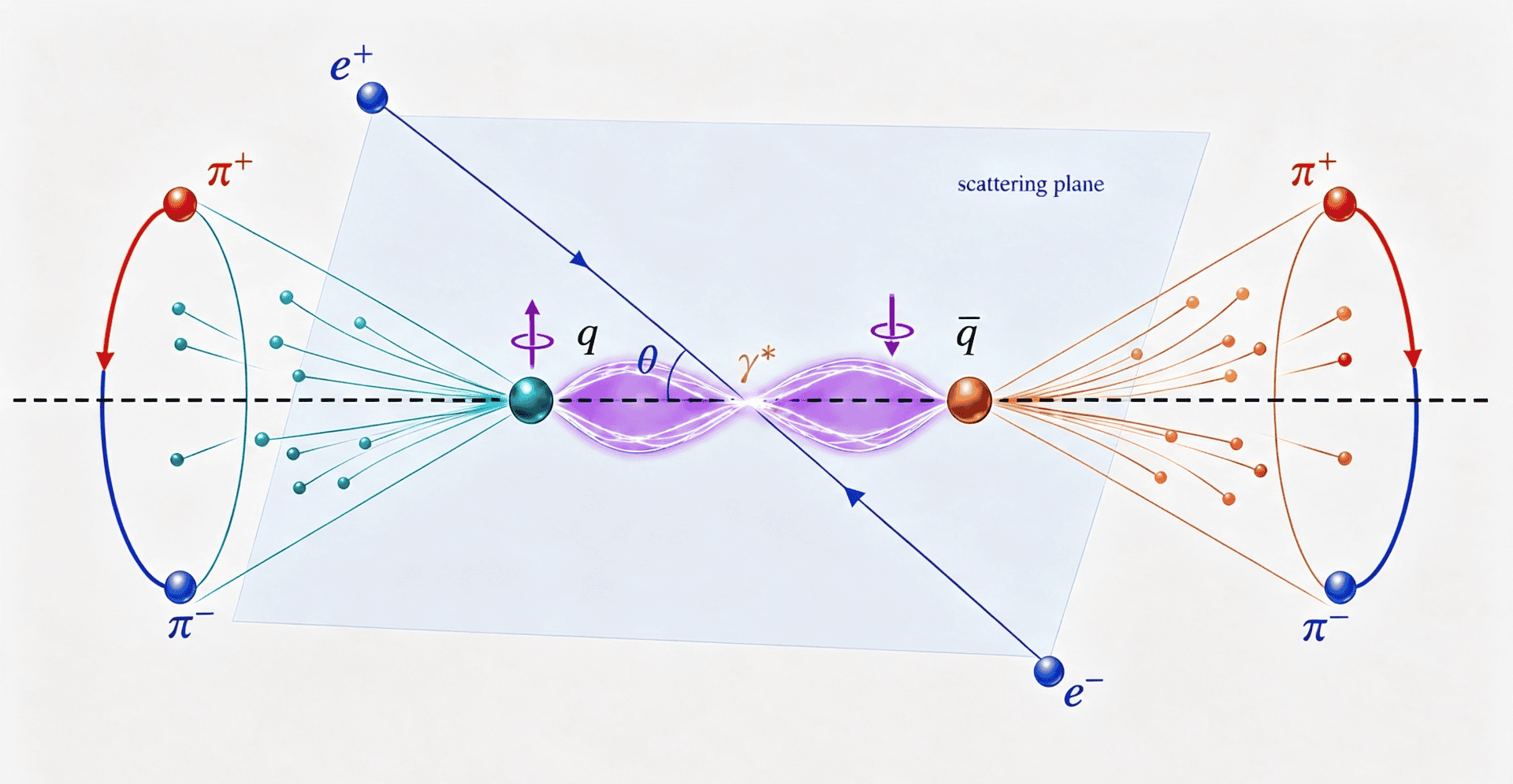
    Schematic of the entanglement-based probe for quarkelectromagnetic dipole interactions.An electron-positron collision produces an entangled quark-antiquark pair. Anomalous magnetic or electric dipole interactions modify the spin correlation of the pair to be opposite orientation, leading to distinct azimuthal angular distributions of the fragmented hadrons. (Courtesy: Xin-Kai Wen/Chinese Academy of Sciences)

    In this work, the authors study electron-positron collisions, which can produce quark-antiquark pairs. These quarks subsequently fragment into hadrons. By analysing the directions in which the hadrons emerge, information about the spins of the original quarks can be reconstructed. The authors show that anomalous magnetic or electric dipole interactions would modify the quantum-entangled spin state of the quark-antiquark pair in a characteristic way, producing either a spin-triplet state (for magnetic dipole interactions) or a spin-singlet state (for electric dipole interactions). These changes lead to measurable signatures in the angular distributions of the resulting hadrons. Rather than searching for an excess of events, the method probes changes in the spin-correlation structure of the quark-antiquark system.

    The work introduces a new entanglement-based approach for probing the electromagnetic properties of light quarks. By connecting quantum spin correlations in hadron production with possible quark dipole interactions, it provides a complementary method for searching for physics beyond the Standard Model using collider data.

    Do you want to learn more about this topic?

    The sea of quarks and antiquarks in the nucleon by D F Geesaman and P E Reimer (2019)

    View Original Article Here

    Share. Facebook Twitter Pinterest LinkedIn Tumblr Email Reddit

    you might also be interested in...

    Francis Halzen wins Nobel Prize in Physics

    Galileo Space Is Building Satellites That Turn Signals Into Answers in Orbit

    Scottish artist marks 100 years of Schrödinger equation with new installation – Physics World

    Deposition Sciences, Inc. Expands Sunshade® Tape Offering with New 12″ × 30″ Format

    Quiz of the week: which star could help astronomers measure the spin of Sagittarius A*?

    why neutrinos keep attracting Nobel prizes – Physics World

    Popular Posts

    Beacon Audiobooks Releases “A Man Named Branch: The True Story of Baseball’s Great Experiment” By Author Marjorie Maddox

    Katie Zacharia fired after five days as White House press secretary

    SpaceX AI policy leader grilled by NYC Council on Grok safety, sexualized images

    Analogue returns to the 16-bit era with the Mega Sg+ and Super Nt+ – Engadget

    A$AP Rocky Recruits Jeremih and Reggie for Shroom Clouds

    Barnes & Nobles Picks for the Best Books of 2026

    Categories
    • Books (2,354)
    • Business (3,322)
    • Cover Story (61)
    • Events (95)
    • Feature (6)
    • Film (1,803)
    • LifeStyle (2,353)
    • Music (2,730)
    • Politics (2,211)
    • Science (2,647)
    • Technology (2,594)
    • Television (2,730)
    • Uncategorized (34)
    • US News (3,171)
    Archives
    Useful Links
    • Contact
    • About
    • Amazon Disclaimer
    • DMCA / Copyrights Disclaimer
    • Privacy Policy
    • Terms and Conditions
    Archives
    Categories
    • Books
    • Business
    • Cover Story
    • Events
    • Feature
    • Film
    • LifeStyle
    • Music
    • Politics
    • Science
    • Technology
    • Television
    • Uncategorized
    • US News
    Facebook X (Twitter) Instagram YouTube TikTok
    © 2026 New York Daily News Online. All rights reserved. All articles, images, product names, logos, and brands are property of their respective owners. All company, product and service names used in this website are for identification purposes only. Use of these names, logos, and brands does not imply endorsement unless specified. By using this site, you agree to the Terms of Use and Privacy Policy.

    Type above and press Enter to search. Press Esc to cancel.