


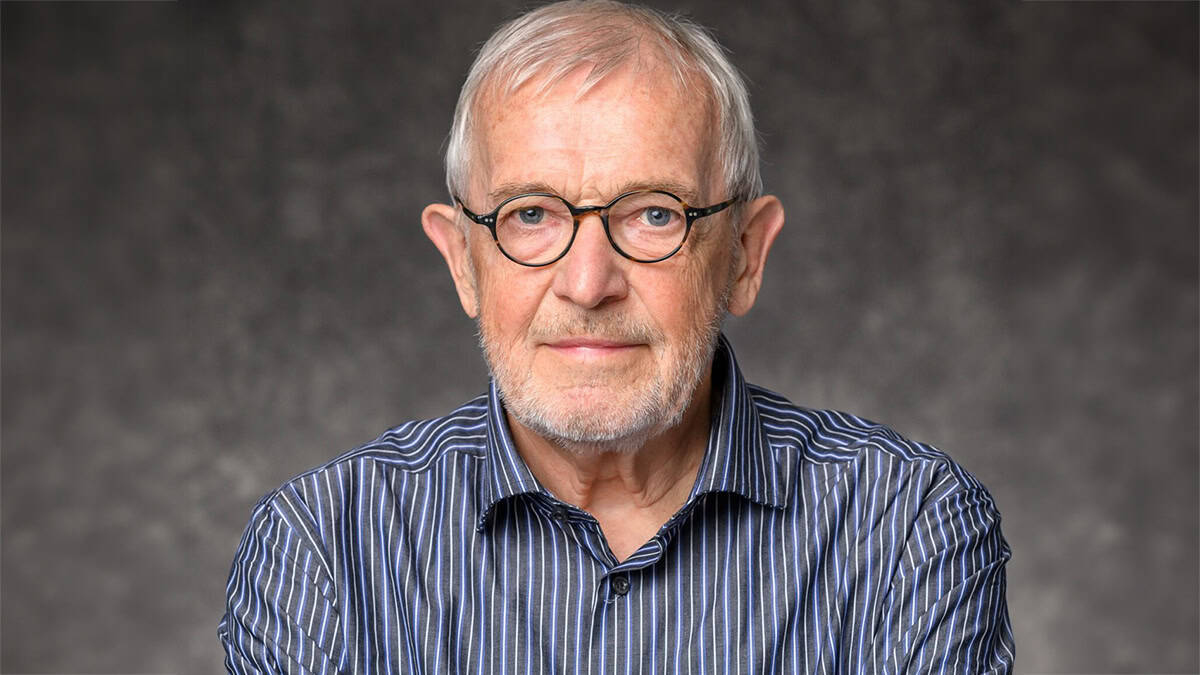
Francis Halzen wins the 2026 Nobel Prize in Physics “for decisive contributions to the IceCube Neutrino Observatory and the discovery of high-energy neutrinos of astrophysical origin”.
The prize will be awarded in Stockholm, Sweden on 10 December and is worth SEK 12 million (about $1.2 million).
Born in Belgium, Halzen is based at the University of Wisconsin–Madison in the US. Nearly four decades ago Halzen realized that the ice at the South Pole could be used to detect cosmic neutrinos. The first attempt was called AMANDA, which was completed in 2000 but not large enough to be up to the task. It was expanded to create IceCube by the end of 2010.
IceCube comprises thousands of light detectors in a cubic kilometre of Antarctic ice. Occasionally a neutrino will interact with the ice and create particles that generate light as they travel through the ice. By tracking these particles, Halzen and colleagues can determine where in the sky the neutrino came from.
Speaking on the telephone shortly after the announcement Halzen said, “It was a great surprise and I didn’t expect it. It’s a great pleasure to hear about this prize.”
“This was an adventure”
He added, “When I reflect on this moment, I have to say how lucky I am. This was an adventure where success was not guaranteed, but we overcame many challenges. It was a long journey. I want to emphasize again how lucky I was to take contributions from collaborators. It feels strange. I hope it reflects on the courageous people who joined me on this project. Many talented people joined me on this journey.”
He was also thankful for the support of his university, “I was lucky to be in the right place [Wisconsin] when this idea [to build IceCube] came up.”
Commenting on whether neutrinos could be used to communicate with extra-terrestrial beings, Halzen quipped, “This has already been proposed by several friends of mine. It has been speculated that this would be an ideal way to communicate with aliens but I don’t think I will go there. I think we have enough realistic problems to deal with right now to make neutrino astronomy a reality.”
When asked what he will do for the rest of today, Halzen replied “I’m working on a proposal. I hope this prize will help get it approved.”
“Halzen had the idea together with a colleague in 1988 to use the ice at the South Pole as a medium to detect neutrinos,” said Mark Pearce, chair of the Nobel Committee for Physics, who is also an astroparticle physicist at KTH Royal Institute of Technology in Stockholm.
International collaboration
Pearce adds, “Halzen has spearheaded an international collaboration of more than 450 people from 58 institutions in 14 countries around the world to realize this enormous neutrino detector.”
Halzen is the first sole winner of the Nobel Prize in Physics since Georges Charpak won it in 1992, with Pierre-Gilles de Gennes being the previous lone laureate in 1991.
This is the fifth Nobel prize related to neutrinos. The first went to the discovery of the muon neutrino, which was recognized by the Nobel committee in 1988. It was followed by the first observation of the neutrino itself (1995), the detection of cosmic neutrinos (2002), and the discovery of neutrino oscillations – the fact that neutrinos can switch from one type to another – in 2015.
Pearce explains why physicists are so fascinated by the elusive subatomic particle: “The neutrino has such peculiar properties, the fact it interacts so infrequently in material, and in this case it’s a way of bringing information about distant cosmic sources that we are unable to acquire in other ways.”
Halzen was born in Tienen, Belgium, in 1944. He graduated with an MSc in physics from the University of Louvain in 1966 and then a PhD from the same university in 1969.
After a stint at the CERN particle-physics lab, he moved to the University of Wisconsin–Madison in 1972, where he also became the principal investigator on the AMANDA neutrino observatory in Antarctica and the IceCube project.
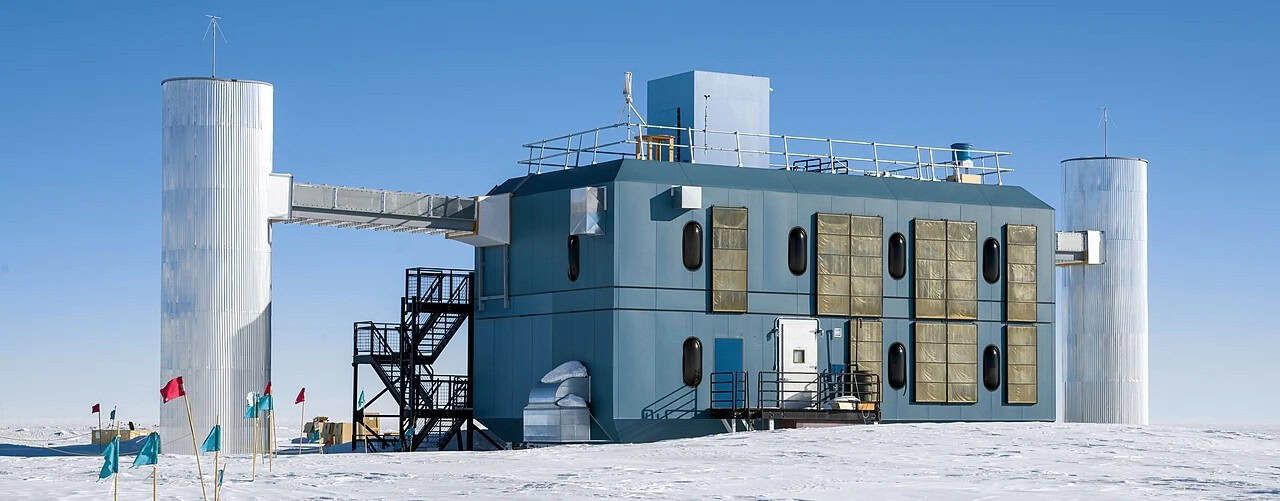
IceCube was completed in late 2010. Then, it comprised 5160 digital optical modules suspended along 86 strings, each up to 2.5km long and embedded under the ice at the Amundsen-Scott South Pole Station. The strings are spaced to create a total detector volume of a cubic kilometre. Neutrinos interact with matter only extremely weakly, so the array instead detects the tiny flashes of Cherenkov light produced when the neutrinos collide with hydrogen or oxygen nuclei inside the ice and create secondary particles. Under ideal circumstances, the detector signal can be used to work out where in the sky the neutrino came from.
In 2013 the IceCube Collaboration published details of its observation of 28 extremely high-energy particle events, created by neutrinos with energies of at least 30TeV. The findings represented the first evidence for high-energy cosmic neutrinos, which originate from outside the solar system.
Two years later, IceCube confirmed the cosmic origin of high-energy neutrinos with an independent search in the Northern Hemisphere. This study examined muon neutrinos reaching IceCube through the Earth, using the planet to filter out the large background of atmospheric muons. Data analysis suggested that more than half of the 21 neutrinos detected above 100TeV were of cosmic origin.
In 2018 IceCube, along with astronomers working on two gamma-ray telescopes, found compelling evidence that a known blazar – called TXS 0506+056a and located about 4 billion light-years from Earth – was a source of high-energy neutrinos detected by IceCube. This was an important milestone in multimessenger astronomy, whereby astronomical objects are studied by observing several different types of radiation.
Another breakthrough came in 2021 when IceCube was the first to spot an interaction called a Glashow resonance. This interaction was first predicted in 1960 and involves the collision of high-energy antineutrino with an electron to create a W boson. In 2022 the galaxy NGC 1068 was identified as a source of high-energy neutrinos and in 2023 IceCube showed that the Milky Way is also a source of high-energy neutrinos.
Earlier this year an upgrade of IceCube added more than 600 new light sensors in five new holes drilled in the ice near the centre of the detector.
- In 2013 Halzen and his IceCube colleagues won the Physics World Breakthrough of the Year award. Hamish Johnston spoke to him about the experiment in this video:
Physics World is brought to you by IOP Publishing, which has a portfolio of more than 100 journals, around half of which are published jointly with or on behalf of partner societies and research organizations. Francis Halzen has published more than 150 papers with IOP Publishing and you can explore them here.

SmarAct proudly supports Physics World‘s Nobel Prize coverage, advancing breakthroughs in science and technology through high-precision positioning, metrology and automation. Discover how SmarAct shapes the future of innovation at smaract.com.