


Denser NAND has made yesterday’s tiny capacities increasingly hard to justify.

Once upon a time, 1GB of flash memory was serious capacity (and it wasn’t cheap either). In early 2002, the industry was abuzz about JMTek’s USBDrive and its up-to-1GB capacity. Today, that same capacity is tiny by consumer standards. Most of Kingston’s current DataTraveler models start at 64GB, with some reaching 512GB.
Storage got ridiculously cheap along the way, and the price collapse was just as dramatic. USB flash storage went from more than $8,000 per gigabyte in its early years to 94 cents per gigabyte by 2013. The basic recipe didn’t change much, since a flash drive still needs a USB connector, controller, circuit board, casing and one or more memory chips. The 1GB drive didn’t become impossible to make. It became a pretty lousy thing to sell.
NAND learned to cram in a lot more data
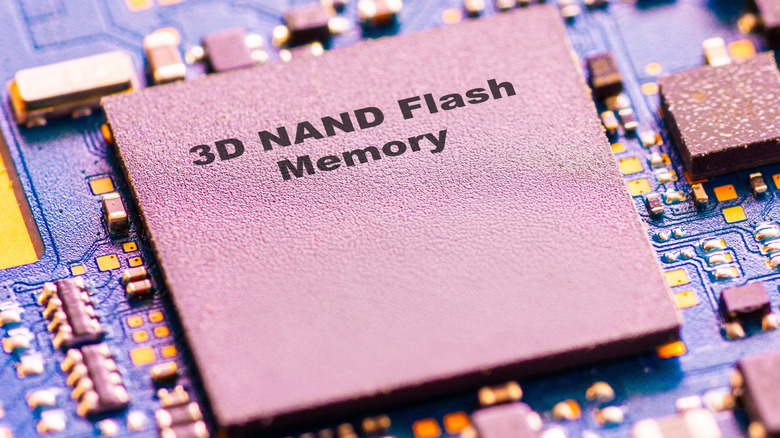
The real trick happened inside those memory chips. For decades, NAND manufacturers have found ways to make memory cells smaller, cram multiple bits into each one and eventually stack those cells vertically with 3D NAND. That lets them pack far more into a flash drive without making the thing so large that you’d need a backpack to carry it.
One neat example came in 2005, when Toshiba and SanDisk announced an 8Gb (gigabit) NAND chip capable of storing 1GB on a single chip. It was less than 5 percent larger than the companies’ previous-generation 4Gb part but offered twice the capacity. In the announcement, the companies said it would become the “production workhorse … bringing significant cost reductions” to the companies’ flash storage products.
The numbers escalated quickly, with a 2.1GB Verbatim Store ‘n Go priced at $250 in 2004. By 2013, Kingston had unveiled a 1TB DataTraveler, while the already available 512GB version cost a fairly brutal $1,750. TLC NAND squeezes three bits into each memory cell and is commonly used in cost-sensitive consumer storage like USB drives. Capacity and speed have both climbed, but larger does not automatically mean faster. The NAND matters, as do the controller and USB interface.
Making tiny drives doesn’t save much
Shrinking a 64GB drive to 1GB doesn’t magically eliminate the rest of the hardware. After all, the low-capacity version still needs a controller, connector, circuit board, casing and packaging. It still has to be assembled, shipped and put on a store shelf too. Once high-density NAND gets cheap enough at scale, cutting storage capacity doesn’t necessarily cut the finished product’s cost by nearly as much.
There’s no neat capacity where the economics suddenly stop working, so there was no magic day when manufacturers decided en masse that 8GB had killed 1GB, but the industry shifted over time. Microsoft’s Windows installation-media tool requires a blank flash drive with at least 8GB of space, making a 1GB stick too small for one of the most ordinary jobs you might give a spare USB drive.
MLC (multi-level cell) NAND is getting squeezed on the production side, too. Global MLC NAND capacity is expected to fall 41.7 percent year over year in 2026 as major suppliers reduce or halt output and put more resources into newer processes. That can create the slightly odd result of an older NAND type getting pricier as supply shrinks.
Small drives haven’t completely vanished. Some survive in industrial and embedded applications where compatibility, endurance or a fixed hardware configuration can matter more than piling on capacity. Delkin sells industrial USB drives starting at 1GB, while Apacer goes lower, with industrial USB flash drives starting at 256MB.
Read the original article here