


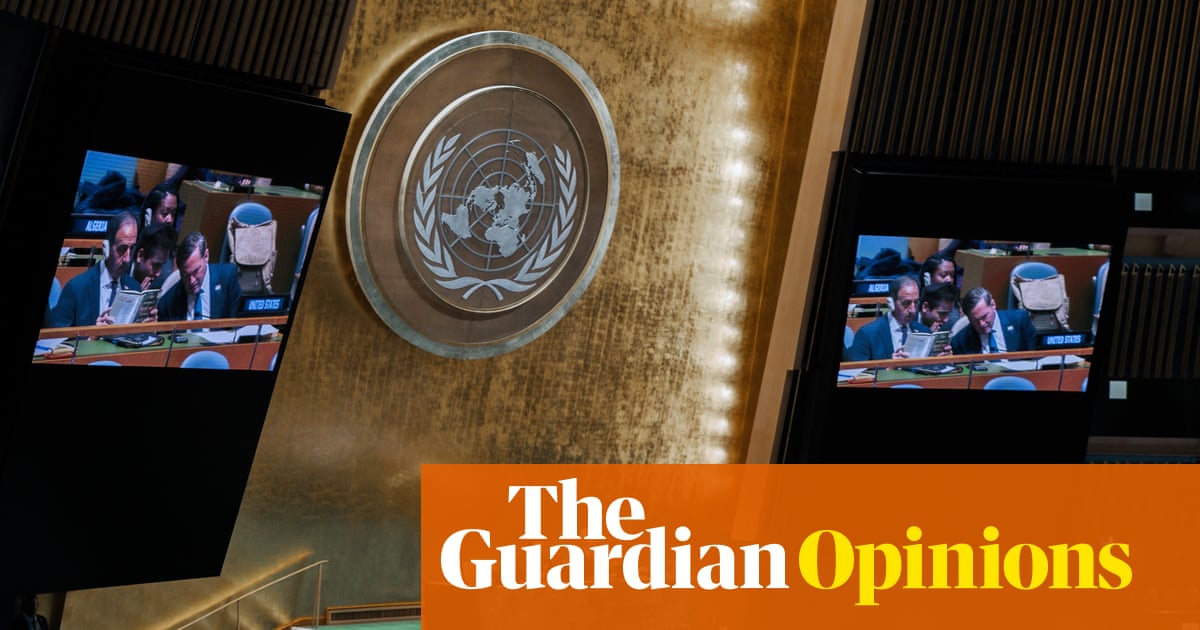
To save the United Nations from the irrelevance in which it now wallows, the next secretary general will require the concerted backing of the few powers that govern the security council.
The paradox is that the great powers who created the institution in the 1940s and recently treat it with a cavalier cynicism are now the ones who need it most, as does the rest of the world.
This is not about nostalgia for what was created after the second world war. That world has changed. We are no longer in the cold war. But it is carelessness of high order to assume that some mystical process will create a world while, in the meantime, the most powerful give license to some dangerous pathologies that have brought us to ruin in the past.
The resort to war over dialogue and diplomacy has reared its head again. Restraint has given way to calculated recklessness. Changing facts on the ground before talking now creates leverage, and that is why we see an unprecedented multiplication of centers of violence. Militias and mercenaries abound.
Collective security to which all commit to be effective is now supplanted by a petulant isolationism. Revolutionary new technologies have spurred a rush to secure minerals and supply routes upending traditional notions of sovereignty. Drone warfare has made violence much more affordable. Frontiers are now up for grabs.
The permanent members of the security council, anachronistically still composed of the victors of the second world war, have a tall order. Quarrels that are as old as tribes, communities and nations now have new, more lethal weapons.
Civil wars, border wars and the return of imperial ambition are not relics. They drive the war in Ukraine, the drift toward conflict in the Horn of Africa, the instability around the Gulf and the Red Sea, and the standoff over Taiwan.
These conflicts are now multiplying at a scale and speed in a time when global regulatory arrangements over existential threats are denigrated. Proliferation of weapons of mass destruction, pandemics, climate change will either be fueled or managed by artificial intelligence.
As AI is woven into military planning, early warning and command systems, it compresses the time leaders have to think before they act, and it multiplies the tools of deception and destabilization. A world that learned, slowly and at great risk, to live with nuclear weapons must now learn to live with machines that may shape decisions about using them.
These dangers can only be contained if we dispense with some misplaced assumptions.
The first is that the UN is a club of the like-minded. It was never meant to be. The UN exists so that states that distrust or even detest one another have somewhere to meet – a place that offers hospitality to adversaries.
If the hard conversations about war and technology do not happen there, where else will they happen in a way that protects the rest of humanity? It is about co-existence, not convergence.
The second assumption is that power can be evenly distributed. It cannot. Pretending otherwise is idealism to the point of fault. A handful of states possess the disproportionate capacity to contain these dangers or to unleash them. In practice, today this means the United States, China and Russia.
But there is no reason to exclude India or a better integrated European Union. Even if they do not trust one another, they need only recognize a shared interest in a world that remains manageable.
This harsh reality should temper the fashionable faith in “middle powers”. Their activism is understandable, even admirable: they see the great powers changing character and are trying to respond. But they are called middle powers for a reason. They cannot, on their own, end a major war or govern a technology developed mostly elsewhere.
This does not mean that might makes right. Neither does it mean that complicated times need simple answers which would be a repudiation of politics at the international level. Power checked by reasonable deliberation, negotiation and diplomacy is a core principle that inspired the charter of the United Nations. This moment calls for a rededication to principled pragmatism.
History has much to teach. When the plague swept Europe in the 14th century, the city states of Italy established the practice of quarantines and an early form of health certification. The science may have been wrong and the system imperfect. But it worked well enough, and it rested on self-interest, not virtue.
Since the mid-20th century, in a radically different technological era, nuclear proliferation and the risk of nuclear war have been contained, so far, through a lengthy process of negotiation and agreements.
Imagine a renewed UN that is a problem-solver rather than a bystander, a credible forum rather than a costly talking shop, and the prime instrument for collective action.
None of this happens unless the great powers want it to. Choosing a secretary general is one of the few moments when they must agree on a qualified person and a timely agenda. The superpowers, middle powers and emerging powers of the global south may each have reasons for skepticism. But they share a stronger reason to make this effort.
We need neither “peace in our time” nor “perpetual peace” – but enough peace to keep civilization.