


For the past few years, my father and I have been writing a book together, a memoir told in his first-person voice. This has required me to do something I never expected to do professionally: imitate Tony Shalhoub. But not the Tony Shalhoub most of the world knows. Not Adrian Monk, the obsessive-compulsive detective he played for eight seasons on Monk, or Abe Weissman, the exasperated father on The Marvelous Mrs. Maisel. The other one. My dad.
Article continues after advertisement
Though, to be fair, I have some experience. As a kid, I practiced forging my father’s signature endlessly. He learned penmanship from nuns, and his signature shows it: perfectly legible, methodical, every letter leaning at the same disciplined angle. I practiced until I could reproduce it well enough to sign the occasional headshot for him—and, when circumstances required, my own permission slips.
Our book, We Thought They’d Never Leave: Musings on Food and Family, is a culinary memoir about my father’s childhood in a Lebanese-American family of ten children in Green Bay, Wisconsin. Structured around our annual family reunion, it also includes twenty of our favorite family recipes. Writing it required me to imagine myself into his memories, his relationships, and his experience of the world. For a year, I was a woman in my thirties attempting to think and write as a man in his seventies. A man who also happened to be my father.
After all, it was a book about family, memory, and tradition. There was something appropriate, then, about doing it together.
As a kid, I handwrote spec scripts for my favorite shows: Friends, Gilmore Girls, Will & Grace. I write fiction, too, inventing characters whose inner lives become so familiar to me that I sometimes forget they don’t exist. Throughout my twenties and into my early thirties, I worked as a professional copywriter, spending more than a decade getting paid to sound convincingly like brands ranging from small e-commerce startups to major tech companies. What I hadn’t done before co-writing this book with my dad was write another person’s actual life in the first person, not to mention someone whose life is so intimately connected to my own.
Before my father and I began writing together, I had some concerns. Would we take each other’s edits personally? Would disagreements about the writing become disagreements between a father and daughter? I know all too well how “constructive criticism” can feel like an attack on your character when it comes from someone you love. But we turned out to be surprisingly good at working together, even when we weren’t in the same room.
It worked like this: First, we got together and made a list of the stories he wanted to tell, and then he went away and wrote them. I would also give him prompts, specific memories or experiences I wanted to know about. Working on this book wasn’t a matter of my interviewing my father and turning the transcripts into a book. We were writing it together, and from the beginning, we wanted that collaboration to be part of the book’s identity. After all, it was a book about family, memory, and tradition. There was something appropriate, then, about doing it together.
When he sent me pages—sometimes nearly finished stories, sometimes rougher ones—I would get to work on them while he continued on to the next chapter. I cut things, moved things around, wrote new passages, expanded scenes, and developed stories that initially occupied only a few sentences. I’ve always been good at holding large projects in my head, seeing how seemingly unrelated ideas connect and how individual stories fit into a larger whole. My father is a natural storyteller, with an extraordinary memory for people, dialogue, and the small details that bring a scene to life. We discovered that our strengths complemented each other.
We share a similar work ethic, too. We celebrated each other’s good ideas, accepted what needed changing, and kept things moving. I suspect this dynamic worked so well because neither of us is particularly precious. I spent years as a copywriter being edited and editing other people, and now run a production company focused on writing and development, where collaboration is essential. My father has spent his career as an actor and executive producer, taking and giving notes, knowing when to push back and when to let something go. We both understood that the goal was to make the book better (and, critically, meet our deadlines).
And yet, the more I wrote about these people as my father knew them, the more I realized that I knew things about them that he didn’t necessarily know in the same way.
Still, I found myself thinking about how an actor can deliver dialogue written by someone else without compromising the authenticity of his performance. In literary nonfiction, though, the relationship between voice and authorship is more complicated. We tend to assume that the person saying “I” is also the person who wrote the sentence. In our book, the experiences belong to my father, but the words sometimes belong to me. We wrote together, yet every “I” referred to him.
I had an advantage, of course, when it came to impersonating my father. I have spent nearly my entire life listening to him speak. I know his expressions, his sense of humor, the particular way he tells a story. I could usually tell when something sounded like him and when it didn’t. But familiarity with someone’s voice isn’t the same as familiarity with their experience. I know how my father talks about the world. I don’t necessarily know how he experienced it.
In fiction, I can invent a character’s memories and decide what they mean. Writing my father’s memoir required a different kind of imagination. I could shape a scene, develop a character, or find language for an experience, but I couldn’t decide what happened or what it meant to him. I was working with someone else’s memories, and that person was sitting on the other end of the phone, perfectly capable of telling me when I’d gotten something wrong. But I also had a lifetime of knowing him to draw upon, and I found that I could often anticipate what he meant, even when he hadn’t quite found the words for it himself.
Part of the work of growing up is separating from our parents, learning to see them as people who exist independently of us. They have lives before we are born, with their own ambitions, disappointments, and relationships. We understand this intellectually long before we necessarily understand it emotionally. There will always be a part of me that sees my dad as simply my dad, the person he has been to me all my life. But at thirty-six, writing this book allowed me to see him more fully as a person in his own right, whose life had begun long before mine. I had to imagine him not as my father but as someone’s son, someone’s brother, a boy whose life did not yet include me. Sometimes I recognized the adult I knew in the boy he described. Other times, the boy seemed entirely unfamiliar. I was reading my father’s life as literature, which required a different kind of attention than being his daughter.
There were moments when the pronouns made this especially strange. I would type “my mother,” but the mother was my grandmother. I would type “my father,” meaning a man I had never met. I would write “my brothers and sisters” about people I knew as my aunts and uncles. But in the book, they were children, and I was writing about them as their brother. I had to imagine people who were familiar to me in roles I had never seen them occupy.
And yet, the more I wrote about these people as my father knew them, the more I realized that I knew things about them that he didn’t necessarily know in the same way. His memories belonged to one generation of our family. My understanding of those same people came from another.
Throughout the book, I tried to see the world through my father’s eyes, but I was also able to bring my own experience to the page, sometimes without quite realizing it.
Both of my father’s parents died before I was born. I have never heard their voices or watched them move through a room except in rare recordings, but I have spent my life among their children, eating the food they taught them to cook and hearing the stories that keep them alive in the memories of their children and grandchildren. Everything I know about my grandparents comes from the people who knew them.
In one chapter of our book, “The Hard Way,” my father recalls his mother, Helen, wondering how her children came to possess qualities she didn’t recognize in herself. It broke my heart to hear him describe her insecurity, knowing from everything I’d heard about her that she might never have understood how much of what she admired in her children had come from her.
As I worked on the chapter, I found myself wanting to answer her. I knew those children, now my aunts and uncles. I knew their generosity, their humor, their kindness, and I knew how they spoke about their mother. I had heard them credit her for the very qualities she couldn’t see in herself. So I wrote that into the chapter, in my father’s voice. I told Helen that the things she admired in her children came from her.
When my father read it, he cried. He wondered how I could have known his mother so well without ever having met her. He was grateful to have been able to say those words to her, even if only on the page. I found it difficult to explain how I had known what to write. I had never met Helen, but somehow, writing as her son, I had found a way to speak to her.
Throughout the book, I tried to see the world through my father’s eyes, but I was also able to bring my own experience to the page, sometimes without quite realizing it. There was something uncanny about the way our perspectives could overlap, how I could find words for memories that weren’t mine and, in doing so, discover something neither of us had quite understood before.
I had set out to pretend to be my father, only to discover that the most meaningful thing I could bring to his voice was my own.
__________________________________
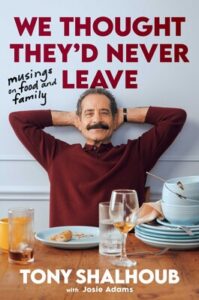
We Thought They’d Never Leaveby Tony Shalhoub with Josie Adams is available from Gallery Books.